
When Menopause Arrives Overnight: What Treatment-Induced Menopause Really Feels Like

By Ms.Medicine Editorial Team
Featuring insights from Dr. Tiffany Troso-Sandoval, MD, Dr. Laila Agrawal, MD, and Dr. Eleonora Teplinsky, MD, from the HERmedicine OncoMenopause speaker series.
Medically reviewed by Dr. Kelli Peiffer, owner and founder of West Side Concierge Medicine
Last updated: September 14, 2026
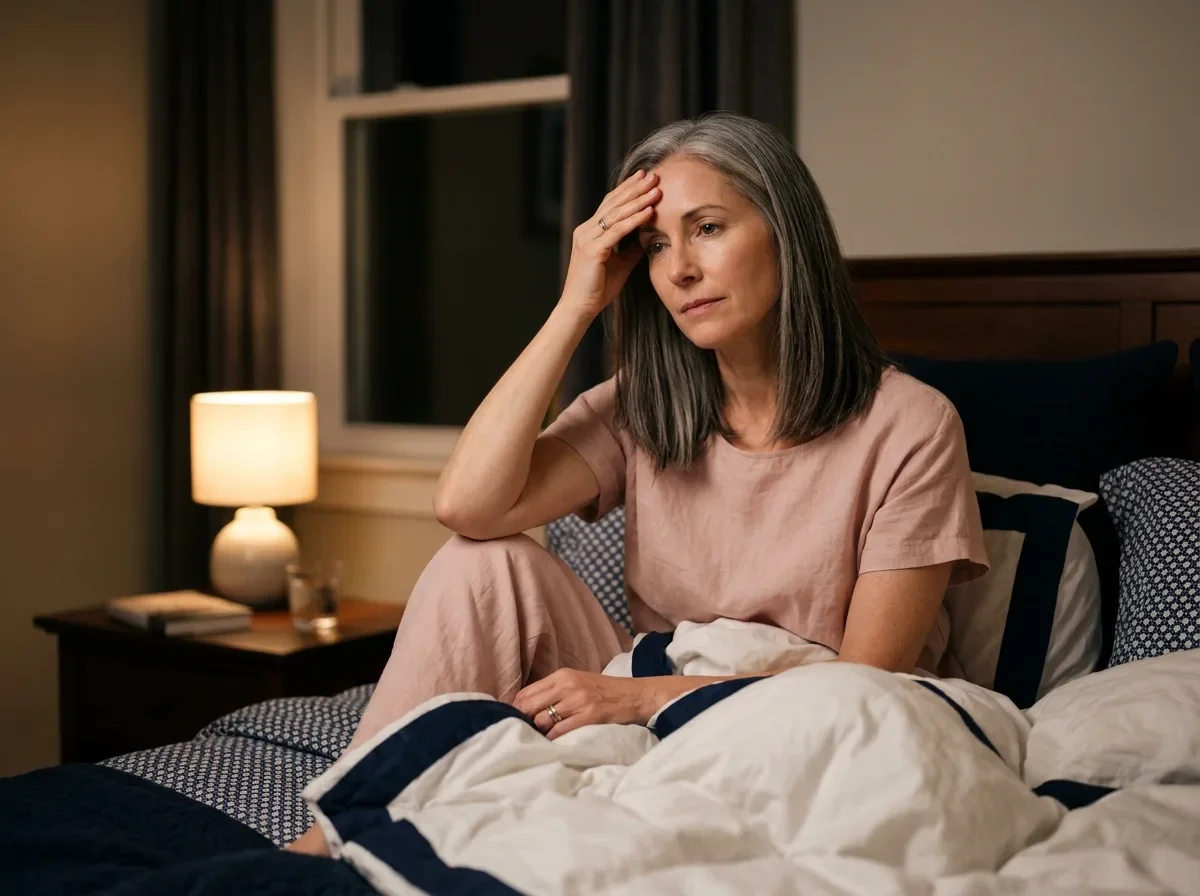
A few weeks into treatment, or sometimes just days after a surgery, a woman wakes at two in the morning soaked through her shirt, heart racing, sheets damp. By the following week it is happening nightly, along with hot flashes that stop her mid-sentence at work and a mental fog that makes her own phone number feel far away. When she describes it to friends her age, they nod along about their own menopause, the occasional flash, the gradual shift over years. Nothing about that matches what is happening to her body. What arrived for them like a slow season changing arrived for her in the span of a few weeks, all at once, at full volume.
If that is your experience, this post is for you. It explains why treatment-induced menopause behaves so differently from the menopause your friends describe, why the intensity is real rather than a sign of weakness, and why survivor menopause deserves to be treated as its own category of care.
Why this doesn't match what your friends describe
Natural menopause is a gradual process. Hormone levels drift downward over years, and symptoms tend to wax and wane, often mild to moderate, with the body adjusting slowly along the way. That version is difficult enough. It is also not what happens after cancer treatment.
Treatment-induced menopause, sometimes called medical or surgical menopause, removes the slow runway. When the ovaries are surgically removed, or when medication is used to switch off ovarian function, estrogen can fall from premenopausal levels to almost nothing in a matter of weeks. As Dr. Tiffany Troso-Sandoval described in her Ms.Medicine talk, the symptoms in these situations are often severe and abrupt, unfolding over weeks to months rather than the years a natural transition allows. That single difference, the speed of the drop, is why the experience can feel so much more intense than the menopause a friend went through. Medical and surgical menopause bring a sudden hormone shift the body has no time to adapt to, a distinction clinicians at institutions like Cedars-Sinai and The Menopause Society emphasize.
The many roads to sudden menopause
Part of what makes this confusing is that there is no single cause. Several different treatments can push the body into menopause, sometimes temporarily and sometimes permanently. In her Ms.Medicine lecture, Dr. Laila Agrawal walked through the main pathways:
Chemotherapy. In a premenopausal person, chemotherapy can induce a temporary or permanent menopause, or sometimes not affect ovarian function at all. The reported risk ranges widely, roughly 20 to 80 percent, depending on age at treatment, the type and dose of chemotherapy, and hormone status beforehand. Ovarian function can also stop for a time and then return months or years later.
Ovarian suppression. Medications given by injection can switch off ovarian function to treat certain cancers. These cause a temporary medical menopause that may lift once the treatment stops, if underlying ovarian function remains.
Surgical removal of the ovaries. When both ovaries are removed, ovarian estrogen production ends immediately, producing the most abrupt onset of all.
Endocrine therapy. Some hormone-blocking treatments do not technically cause menopause, but their side effects closely mimic menopausal symptoms, which adds to the confusion about what is actually happening in the body.
Understanding which road you are on matters, because the path shapes what your symptoms mean and what can be done about them. Broader research on chemotherapy-related amenorrhea confirms just how variable this experience is from one person to the next.
This is biology, not weakness
Somewhere in the middle of all this, many women start to wonder if they are simply not handling things well. That instinct deserves to be named and set aside. Here is how Dr. Troso-Sandoval put it in her masterclass on menopause self-advocacy:
"The abrupt change that breast cancer patients and other patients with treatments that interfere with their ovarian function may go through means they may not suffer from the same volume of symptoms as somebody who has not had this type of treatment. This is not your weakness. This is biology, and it's a legitimate matter, and we need to discuss it."
The scale of this is easy to underestimate. Dr. Troso-Sandoval noted that up to 87 percent of breast cancer survivors experience genitourinary symptoms of menopause at some point, yet only about 25 percent ever raise the issue with a provider. The silence is not because the symptoms are rare. It is because women are so often told, directly or by implication, to simply deal with it.

The symptoms that get brushed off as "just aging"
Menopause after treatment is far more than hot flashes, though the hot flashes are real and often debilitating. The symptoms tend to fall into three broad groups, and naming them, as Dr. Troso-Sandoval teaches, makes it easier to be heard in a clinical setting:
Vasomotor symptoms. Hot flashes, night sweats, and the sleep disruption that follows. In a low-estrogen state, the brain's temperature regulation becomes hypersensitive and overreacts, which is why these can feel so sudden and relentless.
Genitourinary symptoms. Vaginal dryness, pain with sex, urinary urgency, and recurrent urinary tract infections. Dr. Agrawal's research found that long-term sexual health concerns affect more than half of breast cancer survivors, with pain during sex reported by roughly 45 percent in some studies, symptoms that cause real distress and are rarely discussed.
Cognitive and emotional symptoms. Brain fog, memory lapses, anxiety, and depression. These are not a character flaw or ordinary forgetfulness. Changing estrogen levels can affect memory and recall and can raise the risk of mood symptoms.
The trouble is that each of these is easy to misattribute. Brain fog gets waved off as stress, mood changes as a personal failing, night sweats as ordinary aging. When the pieces are treated separately, or dismissed one by one, the full picture goes unaddressed. If you are trying to make sense of having one or more of these symptoms, a Ms.Medicine physician can help you interpret these in the context of your own treatment.

You are not overreacting, and you are not out of options
One of the most validating findings comes from a survey of nearly 1,200 women that Dr. Eleonora Teplinsky highlighted in her talk on non-hormonal management. As she put it, people are often not prepared for cancer-related menopause because it can be so abrupt, and they frequently do not feel supported through it. In that survey, nearly three-quarters of women had less than ten minutes with their doctor to discuss menopause-related concerns, and only a small fraction were ever counseled on lifestyle approaches that can help. That is not a reflection of the women. It is a reflection of a system that has not yet built enough time and expertise around this specific problem.
The encouraging part is that there is a wide range of ways to manage these symptoms. Non-hormonal medications, vaginal moisturizers and other targeted approaches, and foundational lifestyle strategies around sleep, movement, nutrition, and trigger management can all help reduce the burden of symptoms. The right combination is individual, and it is a conversation worth having with a physician who understands the full landscape rather than reaching for a single prescription to quiet one symptom.
Care that treats survivor menopause as its own category
The thread running through all three of these physicians is the same. Survivor menopause is not a harsher version of ordinary aging, and it is not something to be endured quietly. It is a distinct biological event, often sudden, often severe, and it deserves care built specifically for it rather than logic borrowed from the natural transition.
That is the approach at Ms.Medicine. Its physicians understand that menopause arriving overnight, in the middle of cancer treatment or recovery, is its own category with its own needs, and they have the time and the training to treat it that way. Naming your symptoms, understanding which pathway you are on, and building a plan that fits your history is where relief begins. To take a first step, download the Ms.Medicine breast health guide and bring your questions to a physician who will take them seriously.
If you are experiencing anxiety, depression, or thoughts of self-harm alongside these changes, this is a sensitive area, and support is available. A Ms.Medicine physician can help you find the right care and resources.


A woman wakes drenched at 2 a.m., days after surgery or weeks into treatment, and nothing about it matches the gradual menopause her friends describe. That's because treatment-induced menopause isn't a milder version of aging — it's its own biological event, and it deserves its own kind of care.